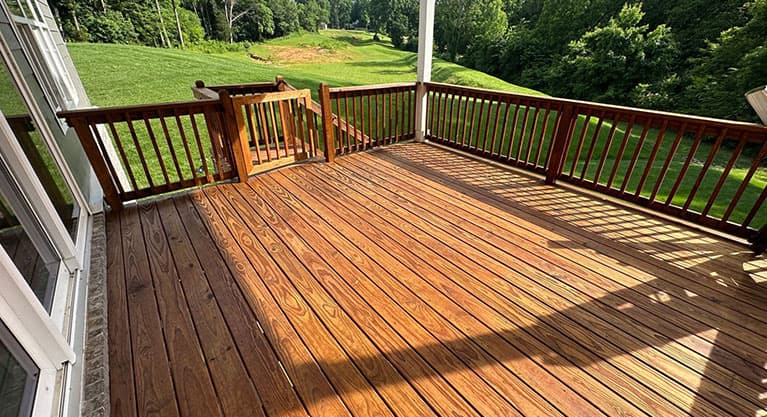
The #1 Mistake Homeowners Make
Walk into any big-box store on a Saturday morning and you'll find homeowners loading their carts with deck stain. Most of them will apply it directly to a deck they swept off this morning. Some will power wash first. Almost none of them will use a deck cleaner, a brightener, or wait the required dry time before applying stain. Within 18 months, that stain is peeling. The real culprit isn't the product — it's the prep. Surface contamination, old stain residue, mill glaze, and wet wood all prevent proper penetration. A stain that can't penetrate sits on the surface and eventually fails.
The Right Prep Process
Professional deck prep has four steps: power wash, deck cleaner application, brightener application, and adequate dry time. The power wash removes loose material. The deck cleaner removes organic matter — mold, algae, and dirt that power washing alone misses. The brightener neutralizes tannins and pH-balances the surface so the stain can penetrate evenly. Then — and this is where most DIYers fail — the deck needs to be fully dry before stain goes on. Depending on weather, that's 24–48 hours. Staining wet wood traps moisture beneath the coating and guarantees early failure.
Penetrating vs. Film-Forming Stains
There are two fundamentally different types of deck finishes: penetrating stains (semi-transparent and semi-solid) and film-forming products (solid stains and paints). Penetrating stains soak into the wood fiber and provide protection from within. Film-forming products build a coating on the surface. For natural wood decks, penetrating stains outperform film products in almost every metric. They don't peel, they're easier to maintain, they allow moisture to escape rather than trap it, and they show the natural grain of the wood. When they wear, they fade gradually — they don't fail dramatically. Film products look great initially but require stripping when they fail, which adds significant cost to every maintenance cycle.
Application Method Matters
Brushing and back-brushing is the professional application method. A brush works the stain into the grain rather than just coating the surface. Sprayers cover faster but leave more product on the surface than in the wood — the opposite of what you want with a penetrating stain. Rolling is acceptable on flat boards but misses the end grain and any crevices. The right method depends on the deck design, but the goal is always the same: get the stain into the wood, not on top of it.
How Long Will It Last?
With proper prep and a quality penetrating stain, horizontal deck surfaces (most exposed to foot traffic and weather) should be recoated every 2–3 years. Vertical surfaces — railings, fascia — often go 4–5 years. Signs it's time to recoat: water no longer beads on the surface, the color has faded significantly, or small checks (surface cracks) are appearing. The best time to stain is before the wood looks obviously bad — a maintenance coat on a surface in good condition is easier, cheaper, and more effective than restoration after the wood has degraded.